.svg) info@scarsandlasers.co.nz
info@scarsandlasers.co.nz
15 Green Lane East, Remuera, Auckland, New Zealand

Monday - Friday: 7:45 am - 5:00 pm

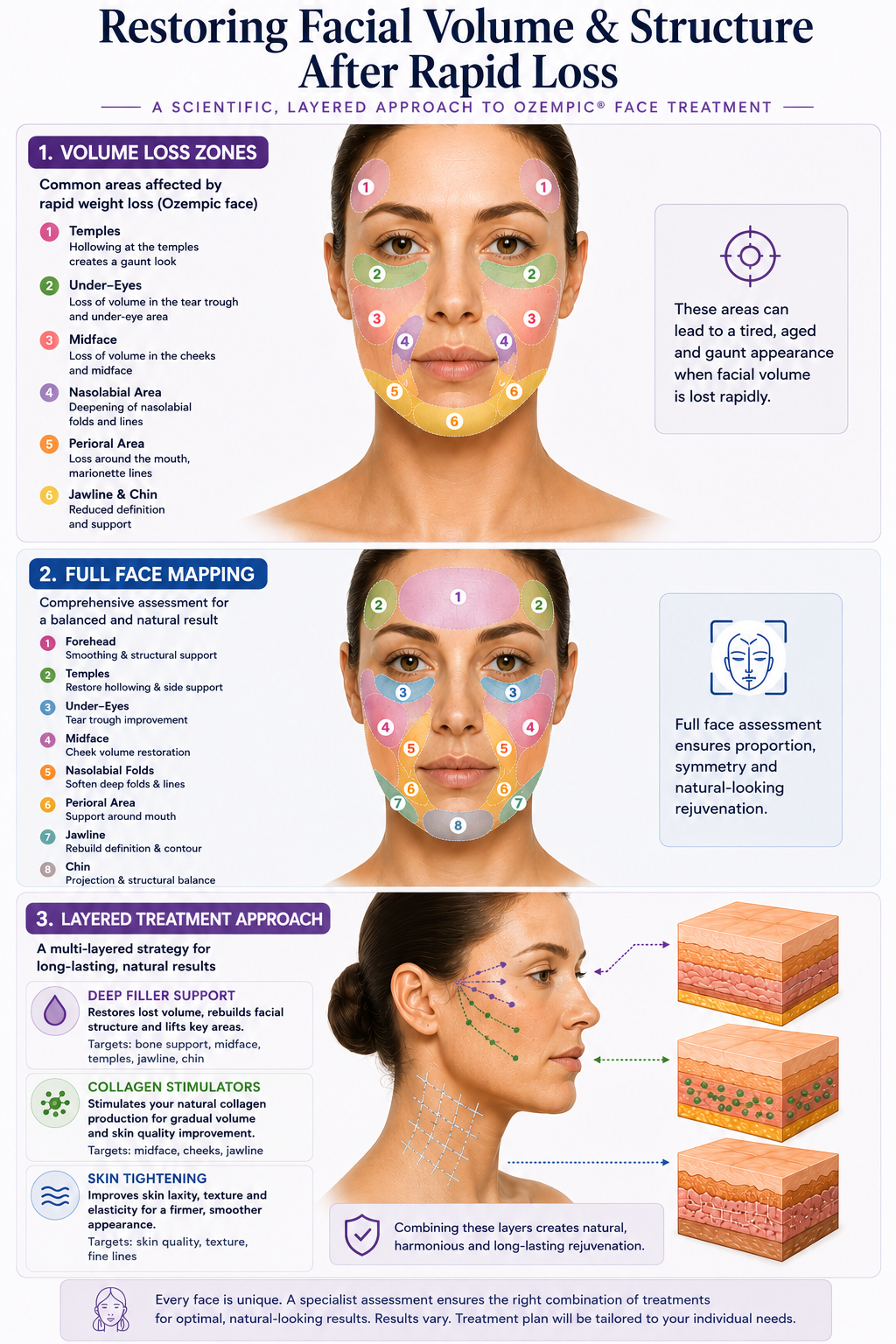
Facial ageing after rapid weight reduction is primarily structural.
When facial fat pads reduce quickly:
Skin has biological limits in its ability to retract. If weight loss occurs faster than collagen adapts, volume depletion and soft tissue descent can become visible.
Importantly, this phenomenon is related to the speed and degree of weight loss, not a disease process. The treatment focus is therefore structural restoration and collagen optimisation — not overfilling.
At Scars & Lasers, assessment considers:
This layered approach allows precise, conservative correction while preserving long-term tissue integrity.
Natural restoration is determined by anatomical judgement, not volume quantity.
At Scars & Lasers, consultations follow a structured injectable governance pathway.
You may book with our Registered Nurse Injector if:
Our Registered Nurse Injector is highly experienced in cosmetic medicine and practices strictly within dermatologist-directed protocols. Where appropriate, cases are internally escalated for Consultant Dermatologist review.
You should book directly with the Consultant Dermatologist if:
This defined pathway ensures appropriate assessment level, medical oversight, and long-term structural governance.

Facial volume loss after medical weight loss is not usually considered a separate medical diagnosis. It is a descriptive term used to explain changes that can become more visible after significant or rapid weight loss, including loss of facial fullness, reduced soft-tissue support, skin laxity and changes in facial contour.
At Scars & Lasers, the focus is on careful clinical assessment rather than treating a label. Each face is assessed individually to understand where volume, skin quality, collagen support and facial proportions have changed, so treatment can be planned in a measured and natural way.
Medical weight loss can reduce fat from the face as well as the body. When facial volume decreases, areas such as the cheeks, temples, jawline and periocular region may appear more hollow or less supported. This can make pre-existing skin laxity, fine lines and structural ageing more noticeable.
These changes do not mean that weight loss has “damaged” the face. Rather, the reduction in facial volume can reveal underlying ageing changes that were previously less obvious. Treatment aims to restore balance, support and skin quality while maintaining a natural appearance.
Treatment depends on the pattern of change. Some patients mainly need subtle volume restoration, while others benefit from improving skin quality, collagen support, laxity and contour.
At Scars & Lasers, treatment may include carefully planned dermal fillers, biostimulatory treatments, skin-tightening procedures, laser resurfacing, UltraClear laser, Endolift, or combination treatment. The aim is not to overfill the face, but to restore proportion, improve collagen integrity and refine facial contour in a staged, specialist-led way.
No. Not everyone who loses weight with GLP-1 medication will notice significant facial changes. The degree of visible change depends on several factors, including the amount and speed of weight loss, age, baseline facial volume, skin quality, collagen support, genetics and previous facial structure.
Some patients experience very little change, while others notice hollowing, laxity or a more tired appearance. A specialist assessment helps determine whether treatment is needed and, if so, which approach is most appropriate.
Filler can be helpful when facial volume has been lost, but it does not address every part of the problem. After medical weight loss, patients may have a combination of volume loss, skin laxity, reduced collagen support, textural change and altered facial contour.
For this reason, filler alone may not always create the most natural or durable result. A more complete plan may include collagen-stimulating treatments, skin-tightening procedures, laser resurfacing or energy-based treatments to improve both the structure and quality of the skin. The goal is balanced restoration, not simply replacing lost volume.
Laser treatments can help improve the quality, texture and firmness of the skin after medical weight loss. While they do not replace lost facial volume in the way that filler or biostimulatory treatments can, they may help improve collagen remodelling, fine lines, skin texture, pigmentation, redness and overall skin integrity.
At Scars & Lasers, laser treatment is often considered as part of a broader rejuvenation plan. This allows facial structure, skin quality and contour to be addressed together rather than treating one concern in isolation.
UltraClear laser can support facial rejuvenation after medical weight loss by improving skin quality, texture and collagen remodelling. It may be used to address fine lines, crepiness, uneven texture and reduced skin firmness that can become more noticeable when facial volume decreases.
Depending on the individual patient, UltraClear may be used as part of a staged plan alongside volume restoration, biostimulatory treatments, skin tightening or other energy-based procedures. The aim is to improve the skin envelope while maintaining a natural, proportionate facial appearance.
Endolift may be helpful for selected patients with facial laxity, early jowling or loss of definition after medical weight loss. It is designed to support skin tightening, collagen stimulation and contour refinement, particularly in areas such as the lower face, jawline and under-chin region.
It is not a replacement for all forms of volume restoration, and it is not suitable for every patient. The best results usually come from careful assessment of whether the main issue is laxity, volume loss, skin quality or a combination of these factors.
Patients who may benefit from Endolift are typically those with mild to moderate skin laxity, early jawline softening, lower-face heaviness or under-chin laxity after weight loss. It may be particularly useful when the concern is reduced definition rather than volume loss alone.
Patients with more advanced laxity, significant excess skin or marked volume depletion may require a different or combined approach. At Scars & Lasers, suitability is assessed carefully so that Endolift is recommended only where it is likely to provide a meaningful and appropriate benefit.
The best time to consider facial rejuvenation is usually when weight loss has stabilised or is close to stabilising. Treating too early, while the face is still changing, may make it harder to plan accurately and may increase the chance that further treatment is needed later.
However, some patients may benefit from earlier assessment, particularly if they are developing significant hollowing, laxity or skin-quality concerns. A staged approach can be useful, allowing treatment to be planned gradually and adjusted as the face continues to settle.
Facial rejuvenation after medical weight loss requires more than simply adding volume. It requires careful understanding of facial anatomy, ageing, skin quality, collagen support, proportion and the way the face changes after weight reduction.
At Scars & Lasers, treatment is delivered within a specialist dermatologist-directed framework. We use staged, anatomically precise planning and may combine injectables, biostimulatory treatments, lasers and energy-based procedures where appropriate. The goal is natural, undetectable restoration that improves facial balance, support and contour without creating an overfilled appearance.
For all appointment enquiries, medical referrals and urgent enquiries please contact us at info@scarsandlasers.co.nz or (09) 524 5011.

