.svg) info@scarsandlasers.co.nz
info@scarsandlasers.co.nz
15 Green Lane East, Remuera, Auckland, New Zealand

Monday - Friday: 7:45 am - 5:00 pm

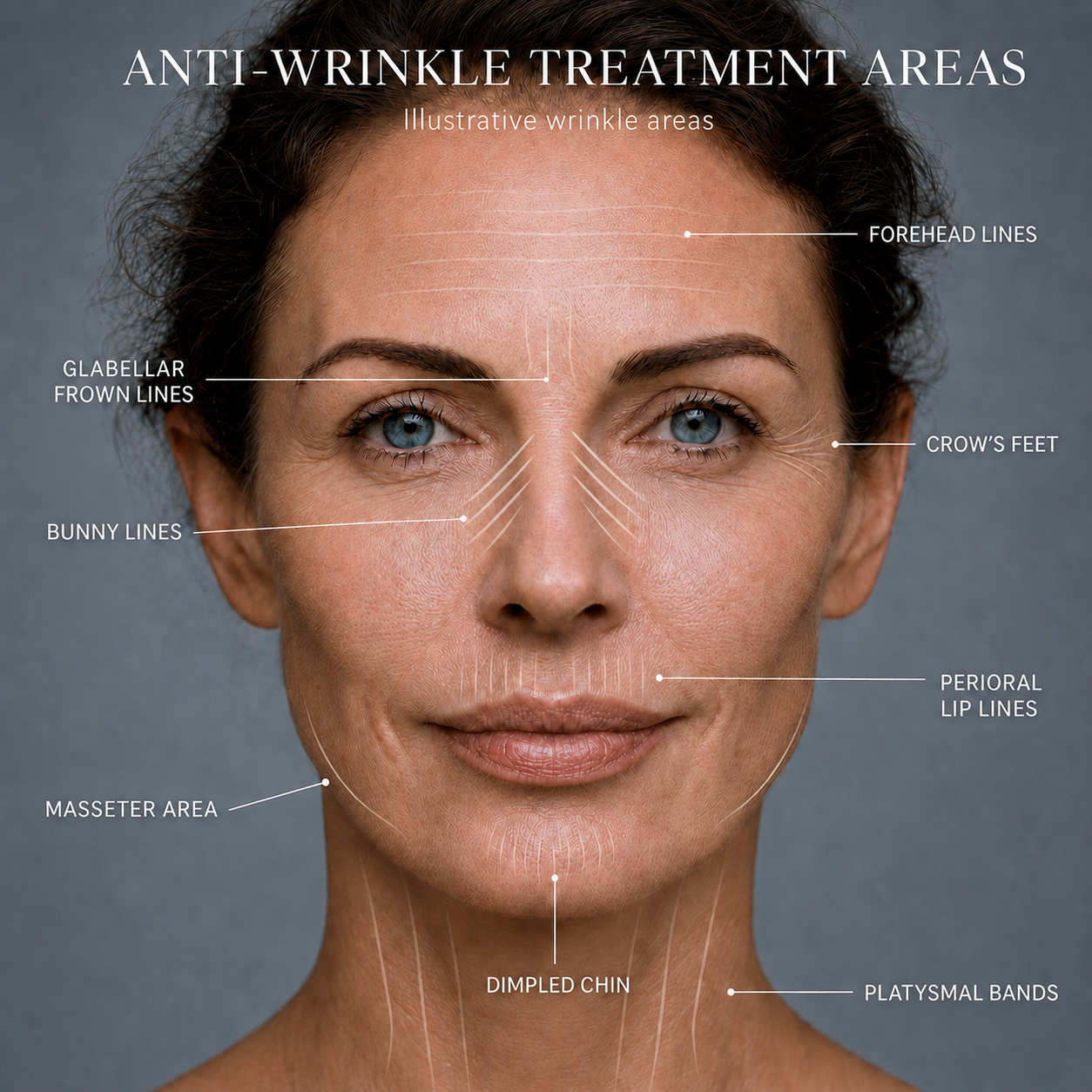
Muscle relaxant treatment uses prescription botulinum toxin to temporarily reduce selected muscle activity. It is commonly used to soften dynamic lines — lines that appear with facial expression — while maintaining a natural, refreshed appearance.
At Scars & Lasers, treatment is provided only after consultation and clinical assessment. We assess your facial anatomy, muscle movement, skin quality, medical history, previous treatments, and treatment goals before advising whether this treatment is suitable.
Our approach is conservative, precise, and tailored. The aim is to soften excessive muscle activity while preserving natural facial expression.
Results develop gradually over several days, with full effect usually seen within two weeks. Treatment is temporary and repeat treatment is required to maintain results. Suitability, risks, alternatives, and aftercare are discussed before treatment.
Anti-wrinkle injections use prescription botulinum toxin to temporarily relax selected facial muscles. Many facial lines develop because repeated muscle movement causes the overlying skin to crease over time, particularly in areas such as the frown, forehead and crow’s feet.
Botulinum toxin works by reducing the signal between the nerve and the targeted muscle. This decreases excessive muscle contraction, allowing dynamic lines to soften gradually while helping to prevent deeper creasing from repeated movement.
The effect is localised, temporary and dose-dependent. Results usually begin to appear within several days, with the full effect typically seen at around two weeks. Over time, normal muscle activity gradually returns, meaning maintenance treatments are required if ongoing results are desired.
At Scars & Lasers, treatment is carefully planned according to facial anatomy, muscle strength, symmetry, skin quality and individual treatment goals. The aim is not to remove all expression, but to soften selected movement while maintaining a natural, balanced appearance.
Botulinum toxin can be used to treat:
Each treatment is tailored to the muscle strength, facial proportions and goals of the individual patient.
Anti-wrinkle injections require more than simply treating a line. Safe, natural-looking results depend on understanding facial anatomy, muscle movement, symmetry, skin quality, eyelid position, brow support and how different facial areas interact.
An expert assessment allows treatment to be tailored to the individual rather than using a standard injection pattern. This is especially important where there is facial asymmetry, eyelid heaviness, low brow position, previous injectable treatment, facial volume loss or skin laxity.
At Scars & Lasers, suitability is assessed before treatment is recommended. The aim is to soften selected muscle activity while preserving natural expression, facial balance and safety.
During consultation, expected benefits, limitations, risks, alternatives and aftercare are discussed so that treatment is carefully planned and clinically appropriate.

Yes. Muscle relaxant treatment can be used to relax the masseter muscles, which are the strong chewing muscles located along the jawline.
This treatment may be considered for two main reasons:
1. Jawline softening or slimming
In some patients, enlarged or overactive masseter muscles can create a square or heavy-looking lower face. Carefully placed prescription botulinum toxin can gradually relax these muscles, helping to create a softer, more tapered jawline over time.
2. Functional jaw discomfort or clenching-related symptoms
Masseter muscle relaxant treatment may also be useful for patients who clench or grind their teeth, or who experience jaw tightness, facial muscle tension, or temporomandibular joint discomfort related to excessive biting force.
Treatment is only performed after an individual consultation and clinical assessment. The aim is to reduce excessive muscle activity while preserving natural facial movement, chewing function, and facial balance. Results develop gradually and treatment needs to be carefully tailored, as over-treatment can affect jaw strength, smile dynamics, or facial proportions.
Muscle relaxant treatment uses prescription botulinum toxin to temporarily relax selected facial or neck muscles. It is commonly used to soften dynamic lines caused by repeated facial movement, and may also be used for selected functional concerns such as jaw clenching, masseter overactivity or excessive sweating.
Treatment is only provided after an individual consultation and clinical assessment.
Anti-wrinkle injections are one common use of muscle relaxant treatment. The treatment works by reducing the strength of selected muscle contractions, which can soften lines caused by expression, such as frown lines, forehead lines and crow’s feet.
The term muscle relaxant treatment is often more accurate, as the treatment can be used for both cosmetic and functional concerns.
Common treatment areas include:
The most appropriate areas depend on facial anatomy, muscle pattern and clinical goals.
Botulinum toxin temporarily reduces the signal between the nerve and the treated muscle. This allows the selected muscle to relax, reducing excessive contraction.
For facial lines, this can soften expression-related wrinkles. For masseter treatment, it can reduce excessive jaw muscle activity. For sweating, it can reduce stimulation of sweat glands in the treated area.
The goal is a refreshed, natural result — not a frozen appearance. Treatment should soften overactive muscle movement while preserving facial expression, balance and individuality.
This is why expert assessment matters. The correct dose, placement and treatment pattern must be tailored to your anatomy.
Results usually begin to appear within a few days, with full effect commonly developing over approximately two weeks.
Some areas, such as masseter treatment, may take longer to show visible contour change because the muscle gradually reduces in bulk over time.
Most muscle relaxant treatments last around three to four months, although this varies depending on the area treated, dose used, muscle strength, metabolism and individual response.
Masseter treatment may last longer in some patients, particularly after repeated treatments.
Most patients find the treatment very tolerable. The injections are quick and use a very fine needle. Some areas may feel like a brief sting or pinprick.
Bruising, tenderness or small temporary bumps at the injection sites can occur.
There is usually minimal downtime. Most patients return to normal daily activities shortly after treatment.
You may be advised to avoid rubbing the treated area, strenuous exercise, facials or lying flat for a short period after treatment, depending on the treatment area and clinical advice.
Potential side effects may include:
Most side effects are temporary, but careful assessment and precise placement help reduce risk.
Yes. Treatment of the masseter muscles may help soften a square or heavy jawline when this is due to enlarged or overactive chewing muscles.
This is a gradual result. The muscle relaxes first, and visible jawline slimming develops over time as the muscle reduces in bulk.
Masseter muscle relaxant treatment may help selected patients with jaw clenching, grinding, facial muscle tension or temporomandibular joint discomfort related to excessive biting force.
It is important to assess whether symptoms are primarily muscular, dental, joint-related or multifactorial. Some patients may also require dental review, a splint, physiotherapy or other care.
Yes. Prescription botulinum toxin can be used to reduce sweating in selected areas by temporarily reducing nerve stimulation to the sweat glands.
This may be considered for excessive underarm sweating or other carefully assessed areas. Treatment suitability depends on the site, severity and underlying cause.
Suitability depends on your medical history, facial anatomy, muscle strength, treatment goals and whether there are any contraindications.
Treatment may not be suitable during pregnancy or breastfeeding, in certain neuromuscular conditions, or where there are relevant allergies, active infection or specific medication considerations.
Yes. A consultation is required before treatment. This allows your clinician to assess muscle movement, facial structure, medical history, previous treatments and desired outcome.
The treatment plan should be individualised rather than based on a standard dose or generic injection pattern.
The required dose varies depending on the area treated, muscle strength, facial anatomy, sex, prior treatment history and desired level of movement reduction.
A smaller dose may be appropriate for subtle softening, while stronger muscles such as the masseters often require a different dosing approach.
In some cases, a review can be arranged after the full effect has developed. If clinically appropriate, a small adjustment may be considered.
It is usually safer to treat conservatively at first, especially in new patients or delicate areas.
If treatment is stopped, muscle activity gradually returns as the effect wears off. Lines or muscle bulk may slowly return toward their previous pattern over time.
Stopping treatment does not usually make wrinkles worse than they were before treatment.
Botulinum toxin is a prescription medicine and requires careful clinical judgement. Results depend on accurate assessment of anatomy, muscle strength, facial balance, dose and injection placement.
Expert treatment aims to achieve a natural result while reducing the risk of unwanted heaviness, asymmetry, altered expression or functional issues.
For all appointment enquiries, medical referrals and urgent enquiries please contact us at info@scarsandlasers.co.nz or (09) 524 5011.

