.svg) info@scarsandlasers.co.nz
info@scarsandlasers.co.nz
15 Green Lane East, Remuera, Auckland, New Zealand

Monday - Friday: 7:45 am - 5:00 pm

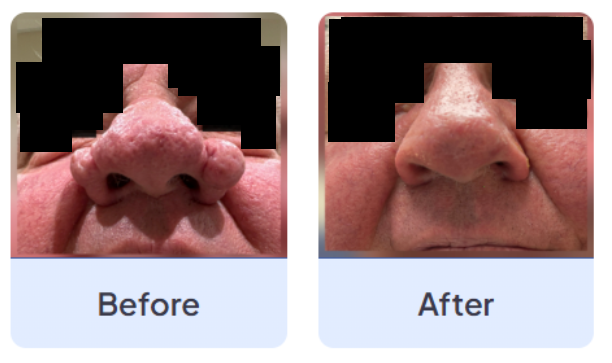
Rhinophyma is a subtype of rosacea—not caused by alcohol—and develops gradually as inflammation, tissue overgrowth, and gland enlargement distort the normal shape of the nose. Over time, rhinophyma can significantly alter nasal contour, but it is highly treatable with modern laser techniques.
Rhinophyma develops through a combination of chronic inflammation, vascular dysfunction, and sebaceous gland hypertrophy, all occurring within the structural framework of the nasal skin. It is considered the most advanced manifestation of phymatous rosacea.
The underlying rosacea process causes instability of the superficial dermal blood vessels of the nose.
This leads to:
Over time, this contributes to thickening, redness, and vascular proliferation.
Sebaceous (oil) glands on the nose become:
This results in:
The nasal skin contains the highest concentration of sebaceous units on the face, making it particularly prone to this process.
Chronic inflammation activates fibroblasts in the dermis, leading to:
This fibrosis is what ultimately distorts nasal shape.
Rhinophyma affects the skin and dermis, not the underlying cartilage.
However, the overlying tissue can become so bulky that it obscures normal anatomical boundaries and nasal contour.
CO₂ and Erbium:YAG lasers:
CO₂ provides controlled bulk removal; Erbium refines and blends, optimising aesthetic and functional outcomes.
(Available on Excel V and Excel V Plus)
Best for
Mild cases or isolated vessels.
How It Works
The long-pulse Nd:YAG laser emits energy at a wavelength absorbed by haemoglobin in blood vessels. This heat causes the targeted vessels to collapse, effectively treating both surface red veins and deeper blue veins.
Results
Treated vessels may disappear immediately or gradually fade over several weeks.
(Candela VBeam Perfecta, Excel V, Excel V Plus, Sciton BBL)
Best for
Stimulating collagen and vascular remodelling to reduce persistent skin redness.
How It Works
Often recommended in combination with vascular laser or BBL treatments to enhance skin healing, texture, and redness reduction.
(Candela VBeam Perfecta, Excel V, Excel V Plus, Sciton BBL)
Best for
More severe cases or large areas of visible facial veins and redness, particularly in rosacea.
How It Works
This approach layers multiple vascular-targeting technologies in one session, including:
Results
Effectively reduces visible veins, diffuse redness, and facial flushing commonly seen in rosacea.
Procedure time: 45–90 minutes (severity dependent)
Anaesthesia: Local anaesthetic, day-stay setting
Downtime: 14–21 days initial healing; residual redness may persist
Sessions: Typically one definitive treatment; refinement if required
Return to work/social activity: 3–4 weeks (case dependent)
Results: Immediate contour improvement with progressive skin refinement

Rhinophyma is an advanced form of rosacea characterised by progressive thickening of the nasal skin, enlargement of sebaceous glands, and irregular surface contour. It can lead to both functional and aesthetic concerns if left untreated.
Rhinophyma develops from long-standing, untreated or poorly controlled rosacea. Chronic inflammation, vascular changes, and sebaceous gland overgrowth contribute to progressive tissue thickening and distortion of normal nasal architecture.
Treatment is procedural and aims to reshape, debulk, and restore normal skin architecture. At Scars & Lasers, this typically involves:
The goal is controlled removal of excess tissue while preserving underlying structure.
Procedures are performed under local anaesthetic, making treatment well tolerated. Post-procedure discomfort is generally manageable and short-lived.
Yes—when performed with specialist dermatology expertise. The aim is not simply tissue removal, but precise sculpting of the nose to restore natural contour and proportion.
Recurrence is uncommon when adequately treated, but underlying rosacea must be managed to reduce future risk. Maintenance strategies may include medical therapy or vascular laser treatments.
Rhinophyma varies significantly in severity and structure. Treatment requires:
A specialist-led approach ensures both safety and refined aesthetic outcomes.
Rhinophyma treatments are delivered within a specialist dermatologist-led model of care, combining procedural expertise with advanced laser technologies. Treatment planning is individualised, with a focus on precision, safety, and optimal long-term outcomes.
If you live outside Auckland or are unable to attend in person initially, we may be able to arrange a virtual consultation before treatment. This allows our specialist team to discuss your concerns, review your suitability, explain the likely treatment approach, and answer any questions before you travel for an in-clinic assessment or procedure.
ACC funding eligibility is determined by the Accident Compensation Corporation on a case-by-case basis. Approval is dependent on injury acceptance, clinical indication, and ACC policy at the time of application. Not all treatments offered at Scars & Lasers are ACC-funded. Private fees may apply for unfunded components of care.