.svg) info@scarsandlasers.co.nz
info@scarsandlasers.co.nz
15 Green Lane East, Remuera, Auckland, New Zealand

Monday - Friday: 7:45 am - 5:00 pm

- For optimal results, lasers are recommended to be used on early cutting scars.
- Vascular lasers are typically spaced out 4-6 weeks apart and can effectively decrease redness and promote collagen remodeling.
- Fractional lasers are suitable for treating both early and established cutting scars. Examples of fractional devices include Acclaro UltraClear, Candela Picoway, Fraxel, and Alma Hybrid lasers.
- The goal of using lasers on self-harm scars is to address both colour and contour of the scar tissue.
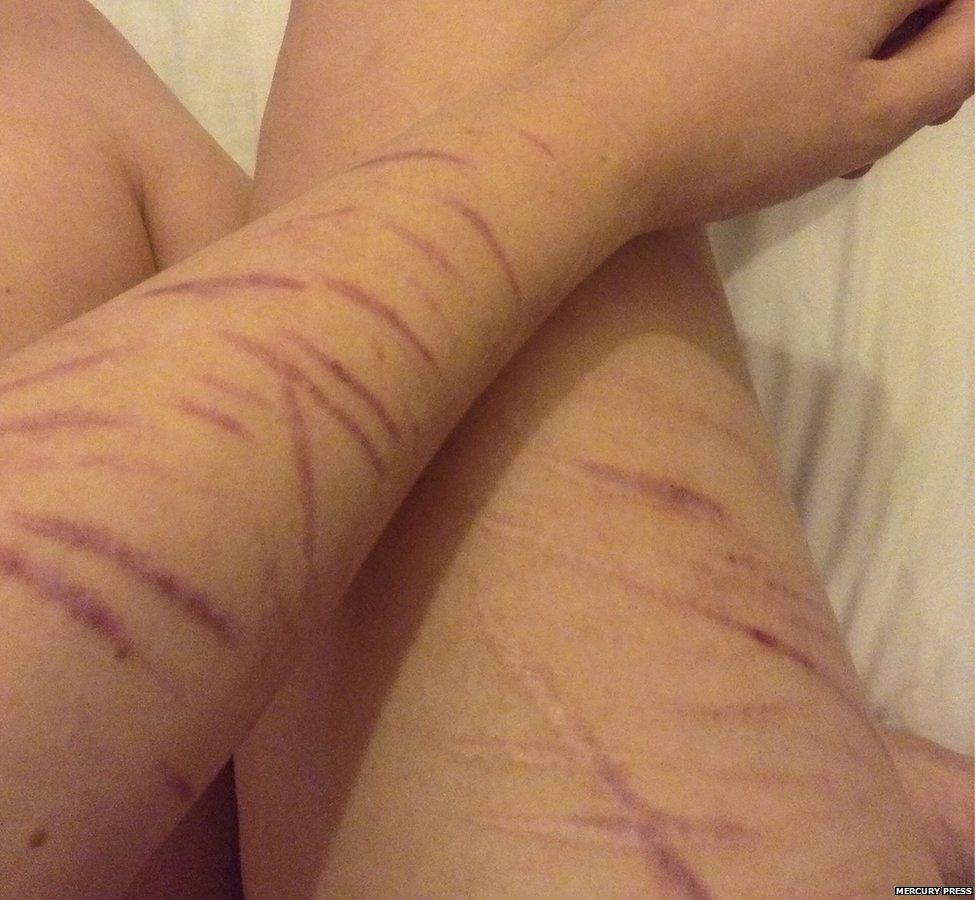
Self-harm scars develop when repeated, sharp injuries cut into the deeper layers of the skin. This disrupts normal healing and triggers the body to rapidly produce collagen in thick, disorganised bundles. Because the same area is often injured multiple times, inflammation lasts longer and the skin repairs unevenly, leading to linear or grouped scars that may be raised, indented, red, white, or darker than surrounding skin.
These injuries also affect pigment cells, blood vessels, and nerve endings, which is why self-harm scars can remain sensitive, discoloured, or texturally irregular for years. Modern laser and energy-based treatments work by remodelling abnormal collagen, reducing redness, and stimulating healthier skin regeneration.
(Available on Excel V and Excel V Plus)
Best for
Mild cases or isolated vessels.
How It Works
The long-pulse Nd:YAG laser emits energy at a wavelength absorbed by haemoglobin in blood vessels. This heat causes the targeted vessels to collapse, effectively treating both surface red veins and deeper blue veins.
Results
Treated vessels may disappear immediately or gradually fade over several weeks.
(Candela VBeam Perfecta, Excel V, Excel V Plus, Sciton BBL)
Best for
Stimulating collagen and vascular remodelling to reduce persistent skin redness.
How It Works
Often recommended in combination with vascular laser or BBL treatments to enhance skin healing, texture, and redness reduction.
(Candela VBeam Perfecta, Excel V, Excel V Plus, Sciton BBL)
Best for
More severe cases or large areas of visible facial veins and redness, particularly in rosacea.
How It Works
This approach layers multiple vascular-targeting technologies in one session, including:
Results
Effectively reduces visible veins, diffuse redness, and facial flushing commonly seen in rosacea.
The best lasers for self-harm scars use a range of technologies to improve scar appearance, texture, and colour. In general, resurfacing-style treatments are best for improving texture and blending (e.g., Alma Hybrid and Acclaro UltraClear), vascular-focused treatments are best when scars are still red/pink (e.g., Candela V Beam), and pigment-focused treatments can help when there’s brown discolouration (e.g., Picoway). Often, the strongest results come from a combination approach matched to scar type and skin response.

The primary goals of scar treatment are to improve colour and contour. When redness is reduced and the texture becomes smoother or flatter, scars become far less visible. Lasers can address both aspects effectively, but each scar has unique clinical features that determine the best treatment pathway.
For self-harm scars specifically, an additional aim is to break up the recognisable patterning of parallel lines that often identify cutting scars. In some cases, this involves combining laser therapy with surgical techniques to disrupt these patterns and create a more natural appearance.
Lasers are highly effective at treating colour changes, especially persistent redness caused by dilated blood vessels.
While white (hypopigmented) scars are more challenging because pigment cells in the scar are reduced, lasers can still help by improving the surrounding skin and enhancing overall blending.
Fractional and resurfacing lasers can also:
Lasers cannot fully correct every type of scar. Deep or wide scars, especially those that extend into the lower dermis, are often beyond what lasers can achieve. These may require surgical repair or, in select cases, skin grafting.
As a general guide, scars that are:
may respond less predictably to laser treatment. Exceptions do exist, but results vary from person to person.
Redness generally responds extremely well to vascular lasers, such as Excel V+, VBeam Perfecta, and Laser Genesis. These treatments target the tiny blood vessels responsible for persistent redness.
Key points:
Fractional lasers (e.g., Fraxel, Acclaro UltraClear, Alma Hybrid and picosecond lasers) work by creating controlled microscopic channels in the skin. This stimulates the body to remodel abnormal collagen and smooth scar tissue.
Different fractional lasers are selected depending on the scar’s characteristics and treatment goals. They can:
Most patients require 3 to 5 sessions, depending on the:
Treatments are typically spaced 3 to 5 weeks apart, with deeper or wider scars often needing more sessions for optimal improvement.
Self-harm scars often appear as linear or parallel lines, sometimes in recognisable patterns. They may vary in depth—from fine superficial marks to deeper cuts—and can create noticeable changes in contour or visibility depending on how the skin healed.
These scars can show:
Yes. Self-harm scars may have changes in sensation, including numbness, sensitivity, or reduced feeling. Some scars feel tight or tethered, particularly when the skin moves or stretches, making textural irregularities more noticeable during motion.
If you have self-harm scars and wish to explore whether treatment may be covered by ACC, you should first see your GP or an urgent care service so that an ACC45 form can be completed and an ACC claim number issued. Once you have your ACC claim number, please contact Scars & Lasers directly.
As an ACC-accredited provider, Scars & Lasers will carry out the specialist assessment, obtain the necessary clinical photographs, and prepare the ACC treatment request and ARTP documentation on your behalf. It is important that further treatment applications are made through Scars & Lasers rather than through your GP or urgent care service, as this ensures the claim is presented appropriately and accurately for specialist scar treatment. If ACC approves the application, your consultation at Scars & Lasers will be covered by ACC.
ACC funding eligibility is determined by the Accident Compensation Corporation on a case-by-case basis. Approval is dependent on injury acceptance, clinical indication, and ACC policy at the time of application. Not all treatments offered at Scars & Lasers are ACC-funded. Private fees may apply for unfunded components of care.