

Surgical Scar Removal
At a glanceSurgical scar removal and scar revision aims to improve the appearance, contour, thickness, colour, tightness, and function of a scar when it remains highly visible, uncomfortable, raised, widened, tethered, or poorly positioned after healing.

Expert Assessment Matters
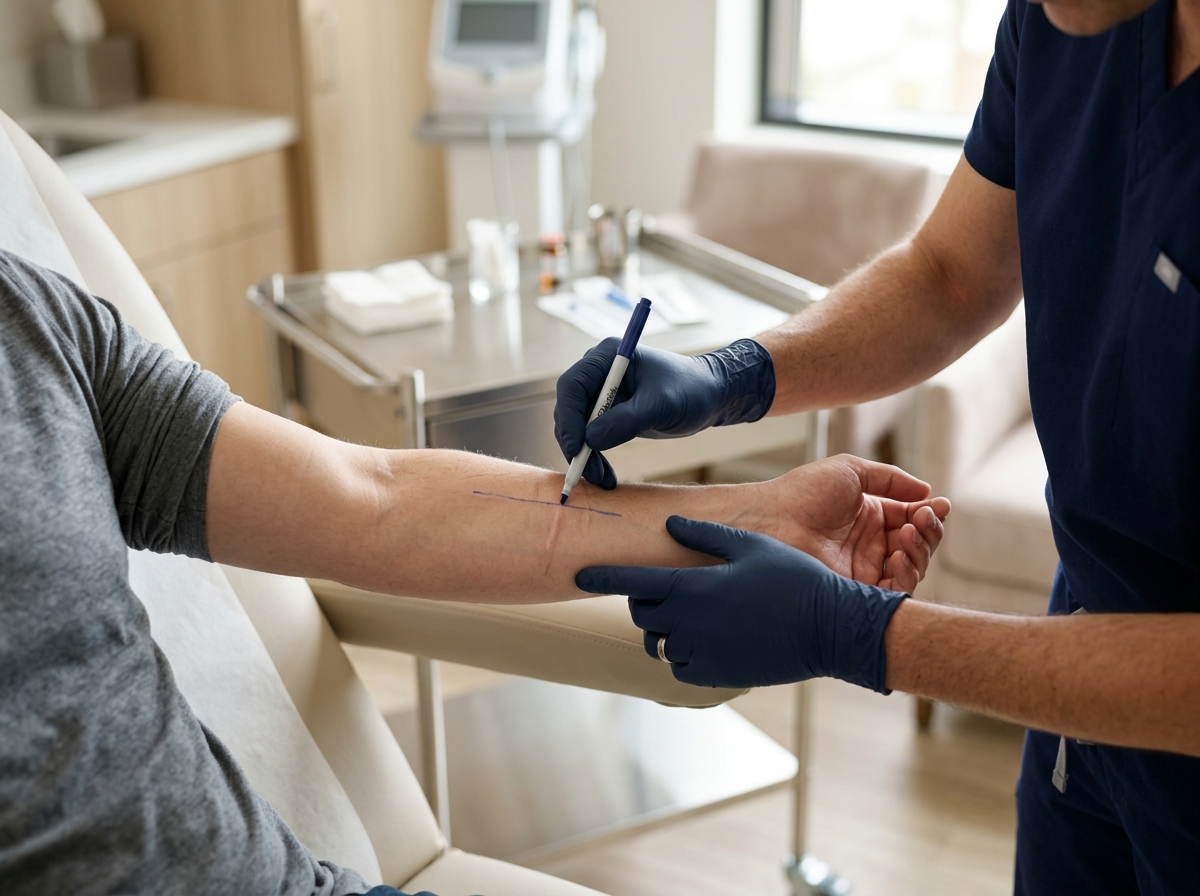
At Scars & Lasers, surgical scar removal is not simply “cutting the scar out”. Specialist dermatologist-directed assessment determines why the scar is visible and which combination of surgery, laser treatment, energy-based treatment, injections, and scar rehabilitation is most likely to achieve the best result.
Some scars are best improved by carefully re-excising and repositioning the scar along natural skin lines. Others require release of tension, treatment of underlying tethering, or correction of raised, contracted, or irregular tissue. In many cases, surgery alone is not enough. The best results often come from combining scar revision surgery with laser and energy-based treatments to address redness, pigmentation, thickness, texture, and recurrent scar formation.
Specialist dermatologist-directed assessment is important because we determine:
- Whether surgery is likely to improve the scar, or whether laser treatment alone may be better
- Whether the scar is hypertrophic, keloid, atrophic, widened, tethered, contracted, pigmented, or vascular
- Whether deeper structures, including muscle or contracture bands, are contributing
- Whether the scar is likely to recur without additional treatment
- Which devices and treatments should be combined with surgery
- Whether ACC funding may apply for traumatic, burn, surgical, or treatment-related scarring
Many scars require a staged approach. For example:
- Surgical revision to improve the position or shape of the scar
- Laser treatment to reduce redness and improve texture
- Additional therapy to reduce thickness, tightness, or pigmentation
- Ongoing scar management to minimise recurrence
This multidisciplinary approach is particularly important for difficult scars such as burn scars, Caesarean section scars, traumatic scars, acne scar excision sites, hypertrophic scars, and scars after cosmetic procedures.
The Science Behind Surgical Scar Removal
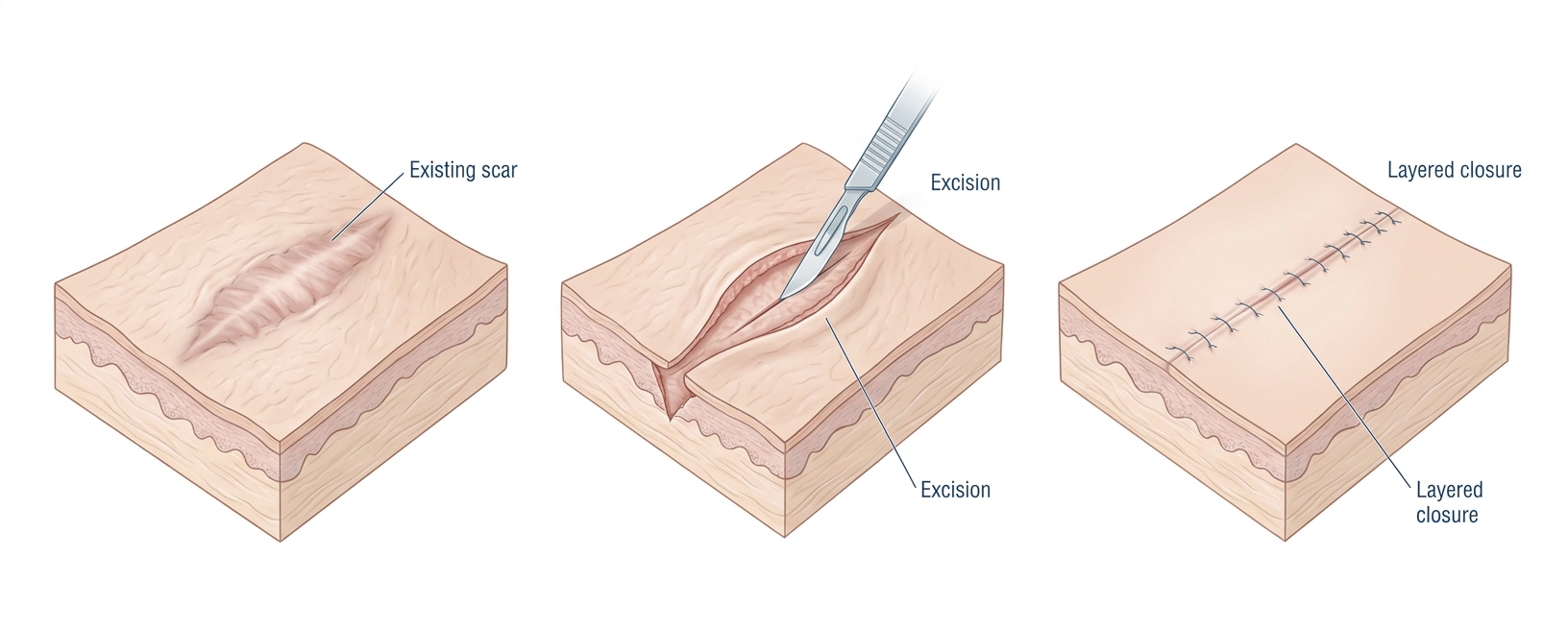
Scar revision works by replacing an abnormal or poorly healed scar with a new wound that is designed to heal in a better way.
This may involve:
- Repositioning the scar so it lies within natural skin lines
- Removing widened or irregular scar tissue
- Breaking up tension across the scar
- Releasing tethering beneath the skin
- Rearranging the scar with techniques such as geometric closure, Z-plasty, W-plasty, or local flap reconstruction
- Improving function when a scar causes tightness or restricted movement
After surgery, the new scar is then guided to heal more favourably. This is where laser and energy-based treatments become important.
For red or vascular scars, we may use:
- VBeam® Perfecta
- Excel® V+
These treatments reduce persistent redness, abnormal blood vessels, and ongoing inflammation that can drive recurrent thickening.
For thick, raised, irregular, or contracted scars, we may use:
- UltraClear®
- Alma Hybrid™
These devices create controlled channels within the scar to soften dense collagen, improve texture, reduce thickness, and stimulate more organised collagen remodelling.
For scars with pigmentation or colour change, we may also use:
- PicoWay®
For raised, thickened, or recurrent scars, laser-assisted drug delivery may be incorporated after fractional laser treatment. This allows medications such as corticosteroids or anti-metabolites to penetrate more effectively into the scar.
This is particularly useful for:
- Hypertrophic scars
- Early keloid scars
- Secondary thickening after surgery
- Burn scar contractures
- Recurrent scars after previous excision
How Surgical Scar Removal May Be Combined With Laser Treatments
Wide or Stretched Scar
- Surgical excision and careful re-closure
- Followed by vascular laser if redness develops
- Fractional laser later if texture remains uneven
Raised or Thickened Scar
- Surgical reduction if appropriate
- Fractional laser combined with steroid or anti-metabolite delivery
- Ongoing prevention of recurrence
Tethered or Depressed Scar
- Surgical release beneath the scar
- Subcision or scar revision
- Fractional laser to improve surface texture
Burn Scar or Contracture Scar
- Surgical release where necessary
- Fractional ablative laser to soften and remodel
- Laser-assisted delivery of steroid or anti-metabolite medication to reduce recurrent thickening and improve flexibility
Red or Persistent Surgical Scar
- Vascular laser to reduce redness and inflammation
- Sometimes surgery is not required if colour is the main issue
Scars
Frequently Asked Questions
No scar can be completely erased. The goal is to make the scar less visible, flatter, softer, narrower, and better positioned. In some cases we can also improve discomfort, tightness, itching, or restricted movement.
Most scars should be allowed to mature for at least 6–12 months before considering revision. However, some scars may benefit from earlier treatment if they are very wide, causing functional problems, or clearly healing poorly.
Some scars respond well to laser treatment alone, particularly red, mildly raised, or texturally uneven scars. Surgical revision is more helpful for scars that are widened, badly positioned, tethered, contracted, or significantly irregular. Your assessment determines which option is most appropriate.
We commonly assess:
- Surgical scars
- Caesarean section scars
- Traumatic scars
- Burn scars
- Skin cancer surgery scars
- Acne scar excision scars
- Raised scars
- Contracture scars
- Poorly healed cosmetic procedure scars
Some scars, particularly hypertrophic and keloid scars, have a tendency to recur. This is why we often combine surgery with laser treatment, steroid injections, silicone therapy, or laser-assisted drug delivery to reduce the risk of recurrence.
Surgery improves the shape and position of the scar. Lasers improve the colour, thickness, texture, and flexibility of the scar. The combination often produces a better result than either treatment alone.
Depending on the scar, treatment may include:
- VBeam® Perfecta for redness
- Excel® V+ for vascularity and persistent pinkness
- UltraClear for thick, textured, or contracted scars
- Alma Hybrid™ for advanced collagen remodelling
- PicoWay® for associated pigmentation
Laser-assisted drug delivery uses a fractional laser to create tiny channels within the scar. Medication, such as corticosteroid or anti-metabolite therapy, is then applied directly into these channels to penetrate more effectively and reduce thickening or recurrence.
Scar revision is usually performed under local anaesthetic. More extensive scars or complex revisions may occasionally require sedation or theatre-based treatment.
Most people experience swelling, redness, bruising, and mild discomfort for 1–2 weeks after surgery. If laser treatment is also used, redness may persist for longer depending on the treatment intensity and the area treated.
Yes. Burn scars may require a combination of surgical release, scar revision, and laser treatment. Fractional ablative laser and laser-assisted drug delivery can be particularly useful for thickened, tight, or contracted burn scars.
ACC may provide cover if the scar resulted from an accident, burn, injury, treatment injury, or surgery related to an ACC-covered event. Funding is not guaranteed and depends on ACC approval after assessment and submission of appropriate documentation.
Showing 6 of 12 questions
Improving Scars with Precision and Care.
Book Your Consultation
Take the first step towards healthier skin. Leave your details below and our friendly team will be in touch to secure your appointment.