

Iron Infusion Stain Removal
At a glancePersistent grey, bronze or rust-coloured staining after an iron infusion can be safely and effectively faded with gold-standard picosecond laser — under specialist dermatologist-led care.
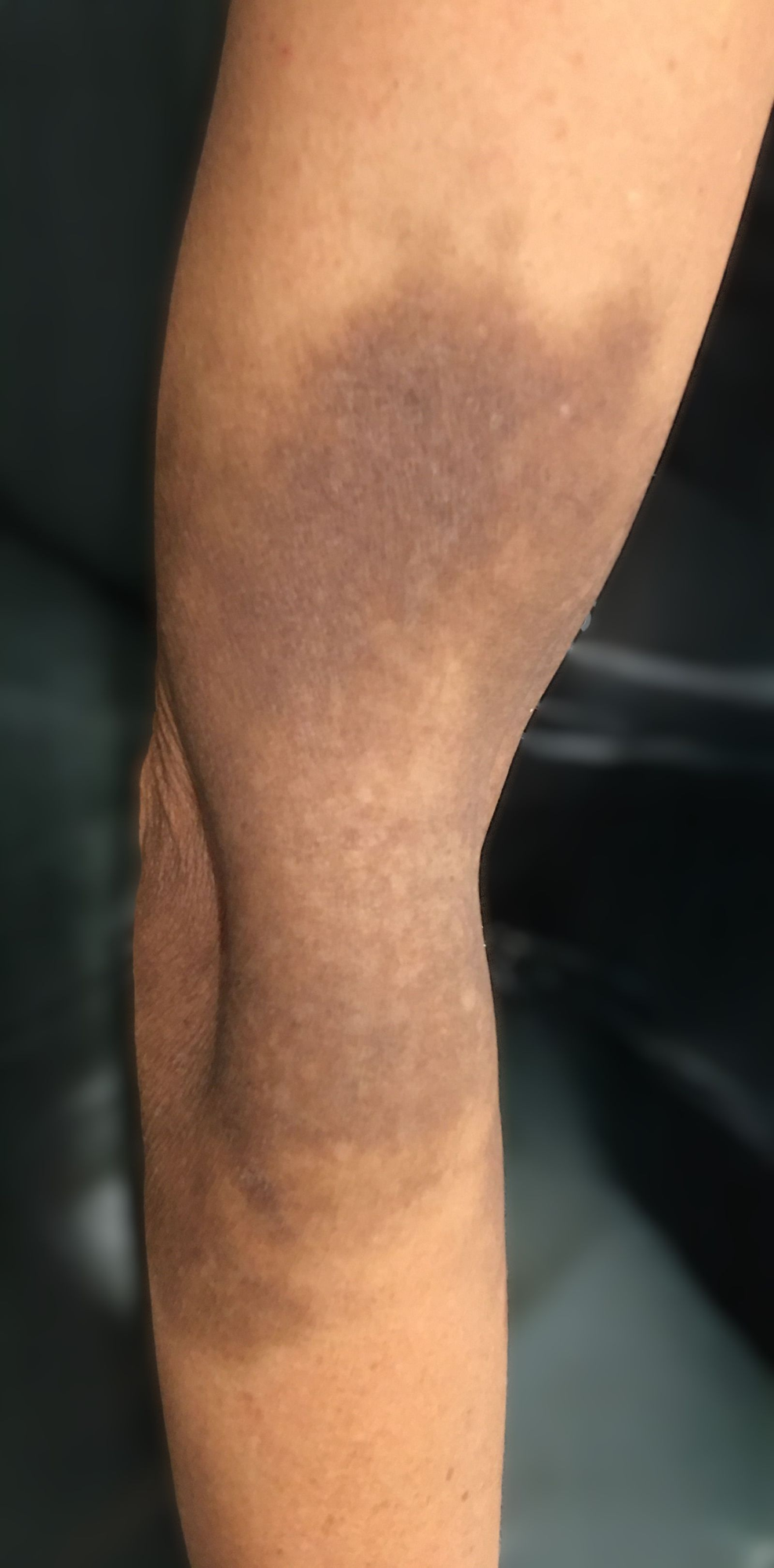

Iron Stain Removal Following IV Iron Infusion or Intramuscular Injection
Iron staining can occur when iron-containing medication leaks from the vein during an infusion, typically due to the cannula being incorrectly positioned or becoming dislodged during treatment. This leads to iron being deposited in the surrounding skin and soft tissue, resulting in a persistent discolouration that may appear grey, bronze, brown, or rust-coloured.
In less common cases, a similar staining pattern can develop following an intramuscular iron injection. These marks can be difficult to conceal and, given their visibility, may cause considerable emotional distress for those affected.
Picosecond laser is the gold standard treatment for iron staining, utilising ultra-short pulse technology to target pigment at the tissue level.
A thorough assessment by a specialist laser dermatologist is essential to evaluate the depth, density, and distribution of the stain, and to map out an individualised treatment pathway.
The goal of treatment is to achieve meaningful fading of the affected area, ultimately restoring confidence and improving quality of life.
Expert Assessment Matters
Iron staining after iron infusions is not a routine cosmetic pigmentation issue. Expert assessment is essential because outcomes and safety depend on factors that are not visible on the surface of the skin.
An experienced laser dermatologist assessment is important to:
- Confirm that the discolouration represents true iron (haemosiderin) deposition, not residual bruising or post-inflammatory pigmentation
- Assess the depth, density, and stability of iron within the skin, which directly affects laser response
- Identify ongoing tissue injury or inflammation, where laser treatment should be deferred
- Screen for neuropathic pain or nerve sensitisation, which can worsen if treatment is performed too early or aggressively
- Select appropriate laser technology and conservative parameters suited to previously injured skin
- Set realistic expectations, as improvement is gradual and complete clearance cannot be guaranteed
- Determine whether treatment is medically appropriate, or whether observation is safer
Because iron infusion staining represents a procedure-related tissue injury, treatment decisions must prioritise skin safety, pain control, and medico-legal appropriateness, not speed or cosmetic outcome alone.
At Scars & Lasers, assessment and treatment planning are dermatologist-led and deliberately conservative to ensure the safest possible approach for this condition.
Treatment at a Glance
Iron Infusion Stain Removal
Frequently Asked Questions
Iron staining (also called iron deposition or iron extravasation) occurs when iron becomes deposited in the skin and soft tissue, producing a brown, rust-coloured, or dark discolouration. It does not wash off and will not fade on its own without treatment.
There are several ways this can occur:
- Intravenous iron infusion — iron solution leaks from the vein into surrounding tissue if the cannula (needle or tube) is misplaced, becomes dislodged, or the vein ruptures during the infusion. The elbow crease and forearm are the most common sites.
- Intramuscular iron injection — iron deposited via injection into muscle can migrate or track into the overlying skin, causing visible surface staining.
- Major trauma — significant injury can cause iron from damaged red blood cells (haemosiderin) to deposit in the skin and soft tissue at or near the injury site, resulting in persistent discolouration.
In most cases, yes. Regardless of how the iron entered the tissue — whether through an infusion accident, an injection, or trauma — the deposits are very difficult for the body to clear naturally. The iron particles bind to skin structures and remain visible as a persistent dark stain without active treatment.
Picosecond laser treatment can effectively break down these deposits, but the sooner treatment begins, the better the result. Fresh deposits respond more readily than older, more deeply established ones.
Yes. Iron deposition in tissue is a recognised complication across several clinical scenarios — including intravenous infusion accidents, intramuscular injections, and significant trauma. In the case of infusion or injection, it is not an intended or expected outcome, and when proper technique and monitoring are in place, it should be preventable.
If this has happened to you, it is reasonable to ask questions about how it occurred and to seek specialist advice about your treatment options. In many cases, the incident may be covered under accident compensation.
The most effective current treatment is picosecond laser therapy. This technology delivers extremely short, precise bursts of laser energy that shatter iron particles into tiny fragments the body can then clear. Unlike older nanosecond lasers, picosecond devices cause less surrounding tissue damage and are particularly well suited to removing iron and other metallic deposits from skin.
Multiple sessions are usually required, spaced several weeks apart, depending on the depth, extent, and cause of the staining.
Most patients with iron staining are candidates for picosecond laser treatment, but suitability is determined on an individual basis following a thorough assessment by your specialist laser dermatology team. There is no single profile that rules treatment in or out — rather, a range of factors are carefully considered together to determine whether treatment is appropriate, how it should be approached, and what outcomes are realistic.
In general, patients who present early — within weeks to months of the staining occurring — and who are in good overall skin health tend to respond best. However, patients with older or more established staining are not excluded and can still achieve meaningful improvement with treatment.
1. Nature of the iron deposit
- Density — how concentrated the iron particles are affects how much laser energy is needed and how many sessions are likely to be required. Denser deposits may need a more staged approach.
- Colour distribution — staining is not always uniform. Patchy or uneven distribution requires careful mapping before treatment begins, to ensure all affected areas are addressed.
- Depth — superficial deposits respond faster and more completely than iron that has tracked deeper into the dermis or subcutaneous tissue. Deeper deposits may require more sessions and may not clear completely.
- Extent — the overall size of the stained area influences how much can be treated per session and the total number of sessions anticipated.
2. Time since the staining occurred
- Recent staining (weeks to a few months) is generally easier to treat — the particles are less deeply embedded and the body's own clearance mechanisms can assist after laser fragmentation.
- Older staining (months to years) may be more challenging, as deposits can become denser, more deeply anchored, and surrounded by scar-like tissue. Treatment is still possible but expectations need to be calibrated accordingly.
3. Skin type
Skin type is assessed using the Fitzpatrick scale (Type I, very fair, to Type VI, deeply pigmented) — one of the most important variables in laser planning.
- Fairer skin types (Fitzpatrick I–III) generally carry a lower risk of unwanted pigment changes and allow for more aggressive settings.
- Darker skin types (Fitzpatrick IV–VI) carry a higher risk of post-inflammatory hyperpigmentation or hypopigmentation. This does not preclude treatment, but requires more conservative settings, longer intervals between sessions, and careful monitoring.
4. Overall skin health at the treatment site
- Active skin conditions nearby — such as eczema, psoriasis, infection, or open wounds — need to be managed before laser treatment can safely proceed.
- Significant scarring over the stained area can affect how well laser energy penetrates and how the skin heals.
- Sun-damaged or very fragile skin may require a modified approach.
5. Medical history
- Certain medications can increase photosensitivity or impair healing — for example, some antibiotics, retinoids, immunosuppressants, and blood thinners. Your full medication list will be reviewed.
- A history of keloid or hypertrophic scarring is relevant, as laser treatment carries a small risk of triggering abnormal scar formation in susceptible individuals.
- Autoimmune skin conditions, or conditions that impair wound healing (such as poorly controlled diabetes), are taken into account when planning treatment.
- Any prior laser treatment to the area is important to document, as the skin's response to repeated treatment can change over time.
- Pregnancy and breastfeeding: laser treatment is generally deferred during pregnancy and is discussed case-by-case during breastfeeding.
Every patient is different. Your specialist laser dermatology team will conduct a comprehensive assessment before recommending a treatment plan, and will discuss realistic expectations, likely outcomes, and any specific risks that apply to your individual circumstances.
Timing is critical. In the weeks after iron is deposited, it is still relatively superficial and loosely bound in the tissue, and the immune system has not yet encapsulated or deeply embedded the particles. Laser energy can reach and fragment these deposits more efficiently at this stage, meaning:
- Fewer treatment sessions may be needed
- Better overall clearance is achievable
- Less risk of residual pigment remaining
Do not wait to see if it fades on its own — it will not. Contact your specialist laser dermatology team promptly.
This varies between patients and depends on the size, depth, age, and cause of the staining, as well as your skin type. Most patients require six to ten sessions, typically spaced six to eight weeks apart to allow the skin to heal between treatments. Your specialist laser dermatology team will be able to give a more specific estimate after assessing the area in person.
Most patients find picosecond laser treatment tolerable. A topical anaesthetic cream is usually applied to the area beforehand to minimise discomfort. During treatment you may feel a snapping or stinging sensation. Afterwards the area can appear red and slightly swollen for a few days, similar to a mild sunburn. Serious side effects are uncommon when the procedure is performed by a trained clinician.
All medical procedures carry some risk. Possible side effects of picosecond laser treatment include temporary redness, swelling, blistering, or crusting of the treated area. Rarely, changes in skin colour (either lightening or darkening) can occur, particularly in people with darker skin tones. Scarring is uncommon with picosecond technology compared to older lasers.
Your specialist laser dermatology team will assess your skin type and tailor settings to minimise these risks. Always ensure treatment is carried out by a clinician experienced with this specific indication.
Possibly, yes. Iron staining resulting from an infusion accident, an intramuscular injection complication, or significant trauma may constitute a treatment injury or accident injury under compensation schemes such as ACC in New Zealand.
In the case of infusion or injection, where the staining was not an intended or expected outcome of treatment, the costs of laser removal sessions may be covered in full or in part if a claim is accepted. Trauma-related cases are assessed on their individual circumstances.
Speak to your specialist laser dermatology team or a patient advocate about lodging a claim. It is worth doing this promptly, as early documentation of the injury strengthens your case.
The process varies by country and scheme. In New Zealand (ACC), your GP or your specialist laser dermatology team can lodge a claim on your behalf by completing a treatment injury or accident claim form. You will need documentation of the original event — whether an infusion, injection, or traumatic injury — along with a medical assessment confirming the diagnosis.
For details on how to begin, see our ACC Skin Injuries & Traumatic Scars page and follow the process outlined there. If you are uncertain, you can also contact ACC directly or speak to a patient advocate for guidance on eligibility and the application process.
Documentation is important both for your treatment and any compensation claim. We recommend:
- Photographs — take clear, dated photos of the stained area as soon as possible, and at regular intervals thereafter.
- Medical records — obtain records of the original infusion, injection, or trauma event, including who was involved, where it took place, and any notes on complications.
- Written account — write down your recollection of events while they are fresh, including when you first noticed the staining and any symptoms experienced.
- Clinical assessments — keep all letters, reports, and referrals from your specialist laser dermatology team and any other clinicians involved.
If you have noticed iron staining — from any cause — take these steps as soon as possible:
- To begin an ACC claim, visit our ACC Skin Injuries & Traumatic Scars page and follow the process provided.
- Do not apply any products to the area without medical advice, and avoid significant sun exposure to the stained area.
- For the best possible outcome, ensure treatment is carried out by a specialist laser dermatology team experienced in iron stain removal.
- Seeking treatment elsewhere, or outside this specialist approach, risks compromising your result.
The single most important thing you can do is act quickly. Early treatment gives you the best chance of a good outcome.
You should be assessed and treated by a specialist laser dermatology team with specific experience in iron stain removal using picosecond laser technology. Not all laser clinics will have treated this condition — it is less common than tattoo removal or general pigmentation treatment, and the clinical approach differs.
When you contact a clinic, ask directly whether they have experience treating iron deposition from infusion accidents, intramuscular injections, or trauma. Your GP can assist with a referral.
Yes. If you live in the Central North Island area and you already have an ACC claim number, we can arrange an initial video consultation where appropriate. This allows us to review your history, photographs, ACC details, and likely treatment options before you travel a long distance for an in-person appointment.
A face-to-face appointment may still be required before laser treatment is performed, but the video consultation can help avoid unnecessary travel in the early assessment stage.
Yes, and this is something we take seriously. Iron staining — whether caused by an intravenous infusion accident, an intramuscular injection, or major trauma — can leave a visible and often permanent mark on an exposed part of the body. For many patients, this goes well beyond a cosmetic concern.
The social stigma associated with visible skin discolouration can be significant. Patients frequently report feeling self-conscious about the stain, particularly when it is on a visible area such as the arm or elbow. This can lead to changes in clothing choices, avoidance of social situations, and reluctance to engage in activities — such as swimming or short-sleeved dressing — that would expose the affected area.
The psychological impact can be compounded by the circumstances in which the staining occurred. When it results from a medical accident — something that was not your fault and could have been prevented — patients often experience frustration, distress, and a loss of trust in medical settings. These feelings are entirely understandable and valid.
If you are finding the emotional impact of your iron staining difficult to manage, please mention this at your consultation. We can discuss appropriate support alongside your physical treatment, and where relevant, this aspect of your experience may also be relevant to your ACC claim. You are not alone in finding this difficult — our specialist laser dermatology team is here to provide clear answers, compassionate care, and a treatment pathway tailored to you.
Showing 6 of 16 questions
Precision laser treatment for iron infusion skin staining and advanced skin tone restoration.
Book Your Consultation
Take the first step towards healthier skin. Leave your details below and our friendly team will be in touch to secure your appointment.