

Burns Scar Treatment
At a glanceBurn scars can cause redness, thickening, tightness, pigment change, itch, discomfort, uneven texture, and restricted movement. They can also continue to change for many months after the original injury. At Scars & Lasers, we provide dermatologist-directed treatment for established burn scars using advanced laser and energy-based treatments, often combined with scar injections, silicone therapy, compression, laser-assisted drug delivery, and selected surgical revision where appropriate.As a private day-stay dermatology and laser facility, we are best suited to treating burn scars that can be managed safely without hospital admission or general anaesthetic.
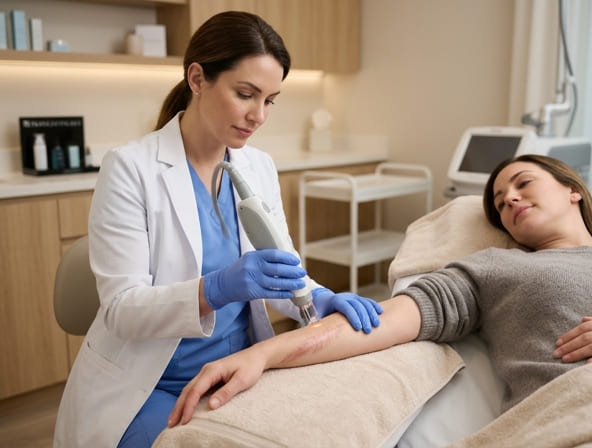

Expert Assessment Matters
Burn scars are often complex. A single scar may involve several problems at once, such as:
- redness
- raised or thickened scar tissue
- tightness or contracture
- uneven texture
- darker or lighter pigmentation
- itch, pain, or sensitivity
Because each of these responds to different treatments, expert assessment is important.
At Scars & Lasers, burn scars are assessed by a dermatologist with experience in scar and laser medicine. We look at the age of the scar, scar activity, thickness, flexibility, skin type, symptoms, movement restriction, and whether the scar can be safely treated in a private day-stay setting.
More severe burns or scars may need hospital-based burns, plastic surgery, or reconstructive care instead.
The Science Behind Burn Scar Treatment
Burn scars form when healing produces abnormal collagen, extra blood vessels, pigment change, and stiff scar tissue. Laser and energy-based treatments target these different scar features in different ways.
Redness and Active Scar Tissue
Red burn scars often contain excess blood vessels. Vascular lasers can reduce redness and may also improve itch, discomfort, and ongoing scar activity.
Thickened, Raised and Secondary Burn Scars
Raised and hypertrophic burn scars contain dense, disorganised collagen. Fractional ablative lasers such as UltraClear® and Alma Hybrid™ create microscopic channels in the scar to soften tissue, improve texture, and encourage healthier remodelling.
These channels can also be used for laser-assisted drug delivery. This may allow medications such as triamcinolone or 5-fluorouracil to penetrate more effectively into thicker or more resistant scars.
Contracture and Tightness
When burn scars become tight and restrict movement, fractional laser treatment can help soften the scar and improve flexibility.
In selected cases, laser-assisted drug delivery with steroid or anti-metabolite medication may also help reduce stiffness and recurrence of tightening. More severe contractures may still require surgery.
Pigment Changes
Burn scars may become darker, lighter, or patchy. Laser treatment may help selected pigmentation problems, depending on the scar and skin type.
Because scar remodelling is gradual, treatment usually requires a series of sessions rather than one treatment.
Frequently Asked Questions
Burn scars are often best assessed once the skin has healed and there is no active open wound. In many cases, treatment may begin within weeks to months of the injury, particularly if the scar is becoming red, raised, itchy, thickened, or tight.
Early treatment can sometimes reduce the chance of a scar becoming more severe.
No. Even older burn scars that are many years old can often be improved. Older scars may not disappear completely, but treatment can frequently reduce redness, improve softness, texture, flexibility, and overall appearance.
Laser treatment is often most effective for:
- Red burn scars
- Thickened or raised scars
- Hypertrophic scars
- Scars causing tightness or reduced movement
- Uneven texture
- Brown pigmentation after burns
Scars with complete loss of pigment can be more difficult to treat, although improvement may still be possible in selected cases.
There is rarely a single “best” laser. The most appropriate treatment depends on the problem being treated:
- Redness and blood vessels: VBeam® or Excel® V+
- Thick, raised, tight or contracted scars: UltraClear or Alma Hybrid™
- Pigment changes: PicoWay®
- Mixed scars: combination treatment
Many patients require more than one type of treatment over time.
Laser-assisted drug delivery is a technique where a fractional laser creates microscopic channels within the scar. Medication can then be delivered more effectively into the scar tissue through these channels.
This is most commonly used for thicker, raised, recurrent, or contracted burn scars. At Scars & Lasers, laser-assisted drug delivery may involve:
- Steroids such as triamcinolone to reduce scar thickness and inflammation
- Anti-metabolite medication such as 5-fluorouracil to help reduce resistant scar tissue and reduce recurrence
Laser-assisted drug delivery may sometimes improve the effect of these medications compared with injection alone, particularly in thicker or more extensive scars.
Most burn scars require a series of treatments. Typically, patients may need:
- 3–6 laser sessions for redness or active scars
- 3–8 sessions for thickened or contracted scars
- Additional sessions for long-standing or severe scars
Treatments are usually spaced 6–12 weeks apart to allow the scar to remodel.
No treatment can completely erase a burn scar. The goal is to make the scar flatter, softer, less noticeable, less red, less tight, and more comfortable.
Most patients experience improvement rather than complete removal.
Yes. While we are able to treat many established burn scars within our private day-stay clinic, there are important limitations.
Scars & Lasers is not a hospital burns unit and we do not provide inpatient care or general anaesthetic surgery. We are therefore not able to manage:
- Very extensive burns involving large areas of the body
- Patients who require treatment under a general anaesthetic
- Acute burns that have not yet healed
- Major contractures requiring extensive reconstructive surgery
- Severe burns requiring hospital admission, multidisciplinary burns care, or ongoing inpatient management
Patients with these more severe injuries are usually best managed within a hospital-based burns, plastic surgery, or reconstructive service. Once the scar has stabilised, selected aspects of the scar may sometimes later be suitable for treatment within our clinic.
Scars & Lasers is a specialist day-stay dermatology and laser facility. We provide procedures using topical anaesthetic, local anaesthetic, tumescent anaesthesia, cooling, and selected oral medications where appropriate.
These approaches allow many scar treatments to be performed comfortably and safely within a private outpatient setting. However, we do not have an operating theatre with general anaesthetic capability or inpatient recovery facilities.
If your scar requires more extensive treatment than can be safely performed with topical, local, or tumescent anaesthesia, we will advise you and, if appropriate, recommend referral to a hospital-based burns or reconstructive service.
Yes. Fractional laser treatment using UltraClear or Alma Hybrid™ can often improve flexibility and help soften scars that are restricting movement. This is particularly useful for scars across joints, the neck, hands, chest, or face.
For more severe contractures, laser-assisted drug delivery with steroid or anti-metabolite medication may also be used to further reduce stiffness and recurrence of tightening.
If there is severe contracture, surgery may still be required, sometimes followed by laser treatment to optimise the result.
Persistent itch, pain, or sensitivity often suggests the scar remains active. Reducing the blood vessels and thickness within the scar may help settle these symptoms.
Treatment may also be combined with scar injections, laser-assisted drug delivery, silicone, compression, or medication where appropriate.
Yes, but darker skin types require particular care because there is a higher risk of temporary or permanent pigment change after treatment.
A dermatologist-directed assessment is especially important so that the safest device settings and treatment sequence can be chosen.
Yes, selected children and teenagers can sometimes have treatment for burn scars, particularly if the scar is thickening, becoming more noticeable, causing distress, or affecting movement.
However, there are important limitations within a private day-stay setting. Most laser and scar procedures require the patient to tolerate topical anaesthetic, local anaesthetic, or tumescent anaesthesia while remaining still during treatment.
In practice, older teenagers are usually more suitable for treatment in our clinic. Many children under approximately 15 years of age may find it difficult to comfortably tolerate these procedures, particularly for larger scars or more intensive treatments.
For this reason, younger children — especially those under around 15 years old, those with extensive scars, or those who would be unlikely to cope with local or tumescent anaesthesia — are often better managed within a hospital-based burns or plastic surgery service where treatment can be performed under sedation or general anaesthetic if required.
Where appropriate, we may still be able to assess the scar, provide advice, and determine whether some aspects of treatment could be safely deferred until the child is older or whether selected, smaller areas may be suitable for treatment in our clinic.
If the burn occurred as a result of an accident or injury, ACC may sometimes contribute toward assessment and treatment.
ACC funding is more likely to be considered where the burn scar is causing symptoms such as pain, itch, tightness, restricted movement, significant redness, or psychological distress, or where there is a clear need for treatment to improve function or reduce ongoing scar activity.
We can assess whether your scar may be suitable for ACC consideration and, where appropriate, provide supporting documentation, clinical photography, and a treatment recommendation or ACC treatment request. Final approval for treatment and funding always rests with ACC.
Showing 6 of 14 questions
Restore structure, refine texture, and rebalance scarred skin with specialist-led burn scar treatment.
Book Your Consultation
Take the first step towards healthier skin. Leave your details below and our friendly team will be in touch to secure your appointment.